Setting a New Standard in Sustainable Manufacturing
In an era where sustainability is no longer optional, Bio-D is proud to stand out as a manufacturing company that has achieved net zero for Scope 1 and 2 emissions. While many companies are working toward reducing their carbon footprint, very few have reached the level of operational excellence and transparency that Bio-D demonstrates. Only around 4% of companies globally meet high-integrity standards for fully verified and transparent net zero targets. Even fewer have Science Based Targets (SBTi) in place that cover all emissions.
At Bio-D, we’re committed to understanding and reducing our environmental impact. We calculate and monitor our carbon footprint as part of this ongoing work, using it to guide meaningful reductions across our operations.
This makes Bio-D’s achievement not just notable; it is truly exceptional.
Scope 1 and 2 emissions represent direct operational emissions. Scope 1 covers greenhouse gases released from activities such as gas use and fuel combustion on-site, while Scope 2 accounts for electricity, heat, or steam purchased and used in operations. By powering our operations entirely with green energy, Bio-D significantly reduces our carbon impact at its source. Unlike many traditional manufacturing sites, which rely heavily on fossil fuels and grid electricity generated from non-renewable sources, our facility runs on clean energy, dramatically lowering our contribution to climate change.
Surpassing Sustainability: Producing More Energy Than We Consume
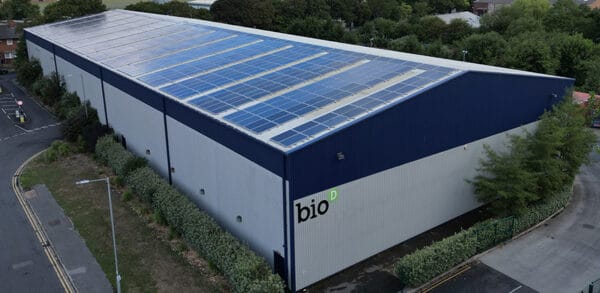
In 2025, Bio-D achieved a remarkable milestone in our sustainability efforts. Our solar energy systems generated over 22.5% more energy than we used on-site. This achievement highlights our commitment to renewable energy and reducing environmental impact.
By producing more energy than we consume, we’re not only powering our operations sustainably but also contributing clean energy back to the grid. This surplus energy reinforces Bio-D’s role as a leader in environmental responsibility and demonstrates that manufacturing can go beyond “neutral” and become positively regenerative.
The Ripple Effect: Businesses Driving Positive Change
At Bio-D, we often talk about the ripple effect—the concept that sustainable business practices can extend far beyond a single company, influencing entire communities and industries. Our commitment to green energy provides a powerful example of this principle in action.
Because Bio-D produces surplus clean energy, we don’t just minimise our environmental impact; we generate energy that can be shared with others. This surplus energy has the potential to power additional households, showing how manufacturing sites can serve as engines for broader environmental benefits.
To put this into perspective, consider the UK’s commercial building landscape. There are approximately 423,000 warehouses across the country. If each warehouse were fitted with solar panels and designed to produce surplus energy, they could collectively generate enough green electricity to power over 4.2 million households. Meanwhile, the UK’s 6,000 multi-storey car parks could produce enough renewable energy for an additional 60,000 homes. Thousands of other flat-roofed commercial buildings remain untapped sources of clean energy. Bio-D’s example demonstrates that by embracing sustainable technologies, companies can transform not just their own emissions but contribute to a wider, greener energy future.
Why Scope 1 and 2 Achievements Are Rare in Manufacturing
Manufacturing is traditionally energy-intensive, with significant emissions generated from heavy machinery, heating, and industrial processes. Transitioning to fully green energy requires substantial investment, careful planning, and a long-term commitment to sustainability. While many companies focus on Scope 3 emissions (emissions from the wider supply chain), fewer prioritise Scope 1 and 2 because of the operational challenges and costs involved.
Achieving net zero for these emissions is rare—and that’s what sets Bio-D apart. By integrating renewable energy technologies, such as solar panels and energy-efficient systems, we have redefined what a low-carbon manufacturing facility can look like. Not only are our emissions neutral, but we also generate surplus energy, proving that sustainability and productivity can go hand-in-hand.
Transforming Manufacturing Into a Force for Good
Bio-D’s commitment illustrates that sustainability is not just about compliance, it’s about leadership. By taking responsibility for our direct operational emissions, we are actively demonstrating how business can be a force for good. The ripple effect we create by generating surplus energy extends beyond our walls, offering a blueprint for other companies to follow.
Investing in renewable energy infrastructure and achieving Scope 1 and 2 net zero has other benefits too:
By showing what is possible, Bio-D inspires the wider industry to reconsider traditional approaches to energy use and carbon management.
A Call to Action: The Untapped Potential of Commercial Energy
The example of UK warehouses and car parks highlights an important opportunity: many businesses operate on large, flat rooftops capable of hosting renewable energy systems, yet few have tapped this potential. If companies were to emulate Bio-D’s approach, the combined energy generated could significantly reduce national carbon emissions and accelerate the transition to a green economy.
Our message is clear: sustainable manufacturing is achievable, and its benefits extend far beyond a single facility. By demonstrating leadership in Scope 1 and 2 emissions and producing surplus energy, Bio-D is paving the way for a new era of responsible, environmentally-conscious manufacturing. Every business has the potential to contribute to a greener future, and the ripple effects of these actions can transform our communities, industries, and the planet.
Leading by Example
At Bio-D, our Scope 1 and 2 operational emissions are net zero thanks to our commitment to green energy. Achieving this milestone is rare in manufacturing, making our facility a leading example of what is possible when ambition meets action.
By producing more energy than we consume and generating surplus clean electricity, Bio-D demonstrates that manufacturing can be regenerative, not just sustainable. We prove that businesses can be powerful agents for positive change, transforming operations, communities, and even national energy systems.
In a world where climate action is urgent, Bio-D’s approach shows that manufacturing doesn’t have to be synonymous with high emissions. Instead, it can be a catalyst for renewable energy, innovation, and environmental leadership, inspiring other companies to follow suit and contribute to a greener, cleaner future for all.